Wings With Memories - First-Hand Account Of A Flight Aboard A Consolidated B-24 Liberator

(Frequent ANN contributor David Juwel had the opportunity recently to take a flight in a Consolidated B-24 Liberator, which remains the sole flying example of a B-24 Liberator left in the world. The aircraft is operated by The Collings Foundation. He offers this first-hand account.)
Prior to the flight I had the opportunity to talk to an actual B-24 pilot from WWII. His name is George Able and he is 90-years old. George was an instrument instructor pilot assigned to the 19th Bombardment Squadron. He flew missions at least twice a week while operating in the New Guinea and Okinawa region. He flew 44 missions averaging 8-10 hours in length, and has about 500 hours in the B-24’s. All of this when he was only 20 years old. When he flew them, they were stripped of their paint (to save the 500 lbs.), which put them in a pool of other aircraft types called, “The Silver Fleet.” Although the aircraft normally holds a crew of 10, George says they would occasionally carry a radar man whose job it was to drop aluminum chaff to try and fool enemy radar, or they would carry a photographer. Some of his flights were weather runs. Back in those days they didn’t have weathermen, so they flew an aircraft out close to where they wanted to go, and they’d call in the actual weather, which would help the brass decide whether a bombing mission could be executed. His wartime flights weren’t as hair rising as some other aircrew experienced. His plane got hit by anti-aircraft fire once, wounding one of the waist gunners, but the crew in back patched the gunner up just fine. Another time, he lost an engine on one of his weather flights, but he says she flew just fine on three engines, and you hardly knew the difference. He told me that the pilots couldn’t see their bomb damage because they were already past the target when the bombs hit, so they depended on the tail gunner to give them a bombing assessment.
Occasionally they’d completely miss the target and their bombs would hit the water instead. Whenever the intelligence officer tried to accuse them of failing in their mission, they’d just tell him they didn’t fail because their target was really the seaplane runway. It’s strange, the love affair you can have with an airplane. Given his age, there are probably a lot of things that have fallen off the memory wagon, but his adoration and memories for this aircraft isn’t one of them.
I had a chance to meet one of the pilots for our flight. She is a petite, brunette, with a Ph.D. Her name is Janeen Kochan (pictured), and she wasn’t who I expected to be flying this wartime bucket of 56-cylinder testosterone – the B-24. In fact, she’s a former DC-8 airline pilot with 16,000-17,000 hours under her belt. And, if that weren’t enough, she is also a Human Factors Scientist and a Designated Pilot Examiner. With her leather flight jacket on, she could pass as a model for a 1943 WASP poster. It was a real privilege having a person of her caliber chauffeuring me through the skies. I was afraid to ask about the experience level of the other pilot. My general aviation ego can only handle so much.
The flight is a cacophony of sight, sound, smell and feeling. Since I’m a big guy, I knew I couldn’t navigate my way across the bomb bay on a catwalk that only has a 9” wide walk area, so I chose to fly in the rear where I had ample room, wide open waist gunner windows, and could experience all of the sensations. I could hear the engines roar to life, hear the brakes squeal, feel the pitching of the tail whenever the brakes were applied, and smell the exhaust from the Pratt & Whitney R-1830-65 engines. I could dramatically feel the swaying of the turn as they applied differential braking for steering. From my position in the rear, I could see everything 180° aft of the wings. Putting my hand out the gunners window at cruise nearly tore it off (just kidding), and yet there was no wind sensation within the aircraft. While you had to shout to be heard, the noise level wasn’t overbearing. The flight was so smooth; you could take pictures without ambient interference.
If you own a camera, you owe it to yourself to take one of these flights. They fly at about 1,000 feet for 30-40 minutes. You can actually wave at the people as they look up with astonishment at what looks like a fully armed WWII B-24 flying overhead. Oh yeah, I forgot. Half way through the flight, I noticed an ME-109 starting a strafing run on us at our 3-o'clock. No problem. I simply grabbed the .50 cal waist gun and smoked him. Mission accomplished.
Flying in the aircraft owned by The Collings Foundation during their Wings of Freedom National Tour (B-17, B-24 & P-51), will leave you with vibrant memories, bragging rights, and a story you can tell forever. Just about every WWII war picture has a WWII fighter or bomber in it. Now when they show one, I’ll have a greater sense of understanding and appreciation. You can too. When they come to a city near you, schedule a ride. If you schedule a P-51 ride, you get to actually take the controls and fly it yourself. What an awesome opportunity. If you come out, and go up, you’ll be supporting history, making history in your own life, and collecting memories of another successful personal adventure.
Source: By David Juwel - 22 February 2012 - Wings With Memories (www.collingsfoundation.org)
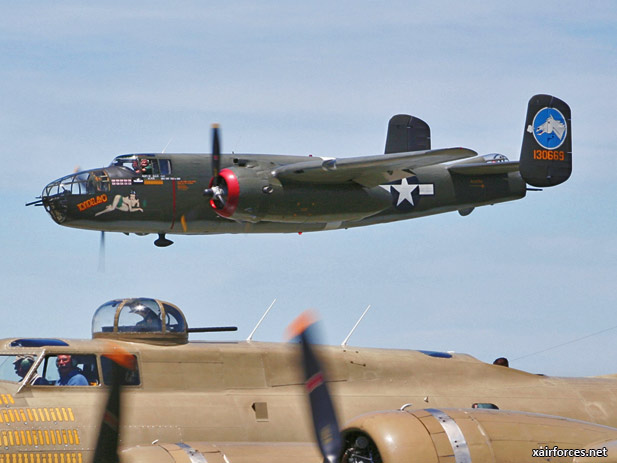
Photo: Collings Foundation U.S. Air Force B-24 "Witchcraft" (Photo by www.airportjournals.com)
(21.02.2012)
|



 4/5 Generation Fighters