Gladiators soar in F/A-18 Super Hornets

Special training last step before pilots head off to war.
No doubt you've seen them overhead. Or, at the very least, heard them.
Strike Fighter Squadron 106 (VFA-106), also known as the Gladiators, are busy right now training the best fighter pilots of the Navy and Marines for war.
Facing the Gladiators in the air is one of the last training regimes in a pipeline of challenges facing the country's best aviators.
If the pilots are assigned to the East Coast (and sometimes the West Coast), they'll have to pass muster with the Gladiators high above Naval Air Station Key West to fly the F/A-18 Super Hornet.
In military speak, the group is known as a Fleet Replacement Squadron. That means it's the Gladiators' job to take green pilots new to the Super Hornet and make them buzz with confidence in the multimillion-dollar death machines.
The squadron got its start on Jan. 11, 1945, in Guam, and has morphed over the years as aircraft and wars changed and was even decommissioned on Nov. 7, 1969, before bouncing back in its current form on April 27, 1984.
The squadron is headquartered at Naval Air Station Oceana, Va., but its frequent visits to NAS Key West have made it a permanent fixture -- literally. The squadron's 1,200 personnel and 120 aircraft have a maintenance detachment at Boca Chica Field.
It's one of NAS Key West's "regular customers," said NAS Key West spokeswoman Trice Denny.
The Gladiators train, on average, about 90 aviators a year. About 40 percent of those include the weapons systems officers who sit behind the pilot, as well as pilots who have been out of the cockpit for extended time and need a refresher course, said squadron Cmdr. Edward White.
"We're taking aviators from strictly a training environment to an operational environment," White said. "The final stage is to land on an aircraft carrier, and when that is completed, they could be assigned to a carrier on a cruise and begin flying combat missions overseas."
Key West's only full-time squadron to call Boca Chica Field home, Composite Fighter Squadron 111 (VFC-111), also known as the Sun Downers, are an adversarial squadron that flies the smaller and older F-5 Tigers when assisting the Gladiators by playing the bad guys during training.
The Gladiators head to Key West typically about six times a year for two weeks each and visit with about 200 people in tow -- on top of the roughly 30 or so personnel that are here year-round, White said.
"We've had a permanent detachment there in Key West as long as I can remember in the 22 years I've been in the Navy," White said. "Key West has also played a vital role in our mission."
Fighter pilots usually fall in love with Boca Chica Field -- or its "range," the area in which the pilots fly their missions -- because it's close to the runway and the visibility is clear most days of the year.
There's also NAS Key West's Tactical Combat Training System -- millions of dollars' worth of secret Northrop Grumman computer systems that analyze a pilot's movements, his or her response to instructors' flight paths and vice versa.
In short, the high-tech gadgetry allows fighter pilots to view their entire sortie in three-dimensional models, as well as view a heads-up display as seen in the cockpit.
Perhaps the clearest evidence of the Gladiators' constant presence in Key West was White's first purchase when he took command of the squadron: "First thing I did was buy a bike and a good lock," he said, laughing.
Source: BY ADAM LINHARDT - Citizen Staff (keysnews.com) News - 20 January 2013
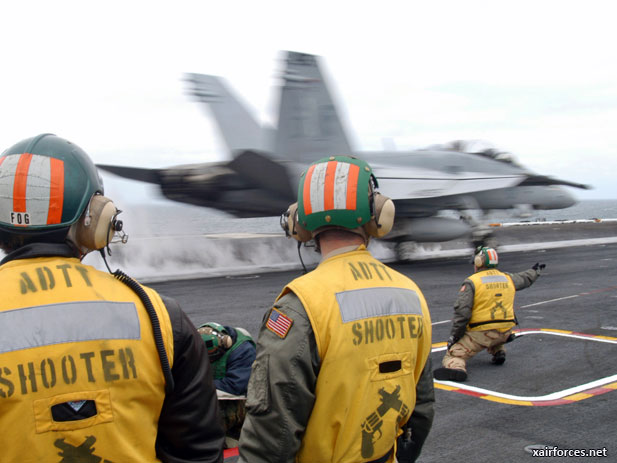
Photo: Atlantic Ocean (May 21, 2005) – Lt. Scott Kramarik, right, launches a F/A-18D Hornet, assigned to the “Gladiators” of Strike Fighter Squadron One Zero Six (VFA-106), off the flight deck of the Nimitz-class aircraft carrier USS Theodore Roosevelt (CVN 71). Lt. Kramarik is one of nine officers assigned to the Air Departments, V-2 Division. VFA-106, the Atlantic Fleet F/A-18 Hornet Fleet Replacement Squadron, is currently embarked aboard the Roosevelt conducting carrier qualifications in the Atlantic Ocean. U.S. Navy photo by Photographer's Mate Airman Christopher Mason (Photo by United States Navy)
(20.01.2013)
|



 4/5 Generation Fighters