Discovery Completes Final Voyage

Shuttle Discovery returned from for the final time on March 9, rolling onto the runway at NASA’s Kennedy Space Center, Fla., where the 27-year-old spacecraft and her six astronauts received a spirited homecoming.
The fleet-leading orbiter touched down on Runway 15 under mostly sunny skies at 11:57 a.m. EST, ending her 39th trip to space with just over 148.2 million mi. on her odometer and an accumulated 365 days in orbit.
The successful 13-day flight leaves just one and possibly two more missions before the three-decade old shuttle program ends. Discovery’s strong performance, with only a small handful of in-flight anomalies that did not prevent two productive one-day mission extensions, is raising similar expectations for the STS-134 and STS-135 missions, which would send Endeavour and Atlantis into orbit before retirement.
“We need to keep the focus,” Bill Gerstenmaier, NASA’s associate administrator for space operations, told a post-landing briefing. “We need to keep the focus on those flights, stay diligent and work those flights just as hard as we did this flight.”
Over a 13-day mission, Discovery commander Steve Lindsey, pilot Eric Boe, Mike Barratt, Nicole Stott, Al Drew and Steve Bowen equipped the International Space Station with the U.S. segment’s last habitable compartment, the Permanent Multipurpose Module, and an external platform for the stowage of spare parts. Discovery’s STS-133 mission delivered five tons of internal cargo, including research equipment. The science gear included Robonaut 2, a joint project between NASA and General Motors to investigate safe human/machine interactions in weightlessness.
NASA Administrator Charles Bolden led the agency’s runway greeting party. He credited the astronauts with “an incredible flight.
“This is bittersweet for all of us,” added Bolden, a former astronaut who flew twice on Discovery. He served as pilot on the 1990 launch of the Hubble Space Telescope.
“It’s a pretty bittersweet moment for all of us,” Lindsey remarked, following the customary post-landing orbiter inspection. “As the minutes pass, I’m getting sadder and sadder.”
Discovery will undergo the customary de-servicing before its is assigned to a museum, presumably the Smithsonian Institution’s Air and Space Museum. Bolden has promised Congress a decision on where all three orbiters will retire by April 12. Discovery is unlikely to leave Kennedy before the fall, and NASA is still evaluating how many of its systems, including the auxiliary power units and hypergolic plumbing, it would like to salvage for engineering forensics.
The scene on Runway 15 was reminiscent of the May 26, 2010, return of Atlantis, which at that point was designated as the first of the NASA orbiters to face retirement. Through re-scheduling and the prolonged troubleshooting of cracks in the stringer section of Discovery’s external fuel tank, the order and pace of retirement changed.
Endeavour was to roll from Kennedy’s Vehicle Assembly Building to Launch Pad 39A, where it will be prepared for an April 19 lift off. Endeavour’s six-member crew will head for the orbiting science laboratory with the $2 billion Alpha Magnetic Spectrometer, an external astronomical observatory. The six-member crew, led by veteran commander Mark Kelly, will be prepared to carry out four spacewalks over the 14-day STS-134 mission.
Atlantis and a crew of four astronauts will be readied for a possible rescue of Endeavour’s crew, an operational change implemented in the aftermath of the 2003 Columbia tragedy. Atlantis will then transition to STS-135, a 12-day supply mission to the station that is currently manifested for a June 28 liftoff. The flight is called for in the 2010 NASA Authorization Act, though it was not included in the most recent series continuing budget resolution.
Veteran astronaut Chris Ferguson will lead a crew of four who would stock the station with enough supplies to weather a possible year-long delay in the start of commercial resupply missions.
Source: By Mark Carreau - HOUSTON - Mar 10, 2011 [AviationWeek]
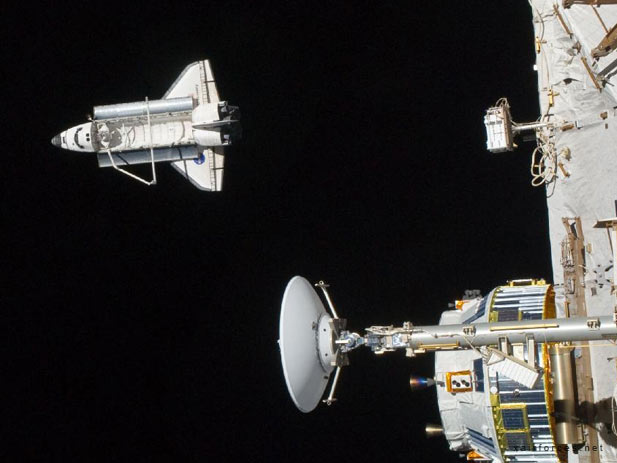
Photo: The Journey Home
The space shuttle Discovery is seen from the International Space Station as the two orbital spacecraft accomplish their relative separation on March 7. During a post undocking fly-around, the crew of each vessel photographed the opposing craft. [NASA]
(10.03.2011)
|



 4/5 Generation Fighters