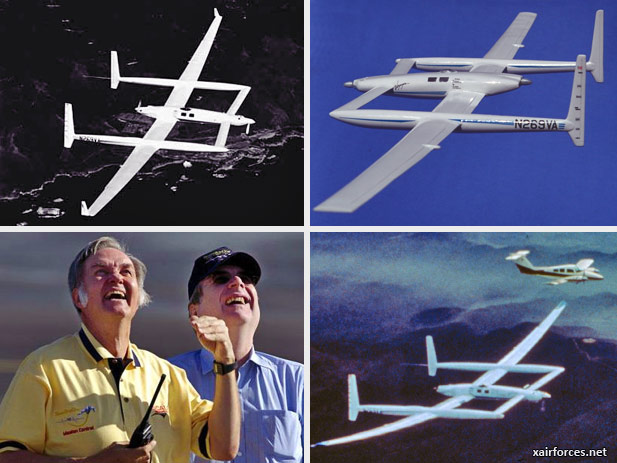
Voyager - From Point A to Point A

Twenty-five years ago, Burt Rutan’s Voyager became the first aircraft to make an around-the-world flight without refueling.
A little after 8 a.m. on December 14, 1986, a spindly white airplane began a takeoff roll at Edwards Air Force Base in California. A crowd of onlookers was surprised to see that as it was rolling, its wingtips were touching the ground. This unexpected development must also have surprised the airplane’s designer, Burt Rutan, who had built the Voyager expressly for this flight (see “Design by Rutan,”). Eventually both wingtips fell off, but that had little effect on the outcome, as pilot Dick Rutan—Burt’s brother—and copilot Jeana Yeager went on to fly around the planet westbound and land nine days later—almost to the minute—on December 23, setting a record and becoming the first aircraft to make an around-the-world flight without refueling.
The flight was unquestionably a test of human endurance, but it also marked a milestone that only someone like Burt Rutan would spend time thinking about. As a designer of experimental and homebuilt airplanes, Rutan had been working for years with modern composite materials of increasing strength and decreasing weight. The design has been attributed to a collaboration of Burt, Dick, and Jeana, but what made the flight—and the airplane—feasible was that the composite materials used to build the aircraft allowed the designer to provide an enormous volume for fuel storage in an airframe light enough to fly with modest power.
The primary material in Voyager is a kind of sandwich: two layers of graphite fiber composite with paper honeycomb in between. Rutan knew that an airplane made of these materials would be light enough to carry the fuel needed to make the round-the-world trip nonstop. Voyager’s airframe weighs only 939 pounds, but its 17 fuel tanks, located in two fat sponsons and the fuselage, carried 7,011 pounds of gasoline. Add the weight of its two engines and its two pilots and it took off at more than 9,700 pounds. What engineers call its “fuel fraction,” the fuel portion of its total weight, is an astonishingly large 72 percent. For comparison, a B-52 (another airplane with exceptional range that has flown around the world, but with inflight refueling) has a fuel fraction of about 64 percent.
Equally important for Voyager’s success was its propulsion. Rutan designed the airplane with two engines, one mounted on the nose and the other on the aft fuselage. The rear engine was a Teledyne Continental IOL-200 rated at 110 horsepower. That’s the same size engine that has powered thousands of Cessna 150s and other light aircraft; this one was modified for Voyager to employ liquid cooling rather than air around its cylinders. In a technical paper describing the engine project (SAE 871042), Ron E. Wilkinson, the Continental engineer in charge, wrote that the engine’s unique parallel liquid cooling arrangement provided very favorable uniformity in temperatures, which, combined with a high-turbulence combustion chamber design, resulted in unusually high fuel efficiency. In the nose was an air-cooled O-240 engine, which delivered 130 horsepower for takeoff and climb. The nose engine spent most of the flight shut down with its propeller feathered so the blades were edgewise to the wind, reducing drag.
Burt Rutan is retired, Dick Rutan lectures and consults on experimental aircraft and engines, and Jeana Yeager went home to Texas, but 25 years ago, they and the team that supported the flight won the National Aeronautic Association’s Collier Trophy for the year’s greatest flying achievement in the United States.
Source: By George C. Larson, Member, NAA, 13 January 2012- Air & Space magazine News (www.airspacemag.com)
Photo:A Rutan Voyager in flight (Photo by flightcrusaders.org). Aircraft Designs of Burt Rutan, Burt Rutan and Scaled Composites (Photo by factoidz.com). Voyager departing the coast of California on Dec. 14, 1986, soon to leave behind Burt Rutan in the Duchess chase plane. (Photo by nasm.si.edu). Voyager (here, over Southern California) took off with 7,011 pounds of fuel; when it landed, it had only 106 .. (Photo by ceutec-aviacion.blogspot.com)em>
(13.01.2012)
|



 4/5 Generation Fighters