CMV-22B Osprey Strengthens USN Carrier Operations

The CMV-22B Osprey has quickly proven itself as a vital addition to the US Navy’s fleet, replacing the aging C-2A Greyhound that has served carrier-onboard-delivery missions since the 1960s.
While the Greyhound was capable of carrier landings, it lacked aerial refueling capability and offered limited range compared to modern requirements.
The navalized Osprey variant delivers significant improvements. With increased fuel capacity, it achieves a greater operational range than the Marine Corps’ V-22 Osprey and extends about 150 miles beyond the Greyhound’s reach. Its ability to land like a helicopter enables night operations and streamlines rapid landing, unloading, reloading, and takeoff procedures.
Vice Admiral Whitesell emphasized the aircraft’s flexibility: “The Osprey has the ability to get on and off the deck in rapid fashion. I don’t have to clear catapults for COD operations. I can land it like a helicopter, reposition it, and return it to holding patterns as soon as cargo is offloaded or before loading begins.”
The Navy highlighted the Osprey’s operational success during its first deployment in summer 2021, when Fleet Logistics Multi-Mission Squadron (VRM) 30 embarked on the USS Carl Vinson (CVN 70) alongside F-35C Lightning II and E-2D Advanced Hawkeye squadrons. The detachment achieved a 98% mission completion rate and a 75% mission capable rate, underscoring the aircraft’s reliability.
Beyond logistics, the CMV-22B is essential for transporting F-35 power modules and supporting next-generation carrier air wing deployments. Despite maintenance cycles similar to the Greyhound, the Osprey demonstrated higher readiness levels during its inaugural deployment.
Vice Admiral Whitesell noted: “With the C-2, mission capability hovered around 66% due to phased maintenance. The CMV-22B maintained a comparable rate, but now we are applying a class-wide maintenance plan across all platforms, ensuring long-term sustainability.”
,
The CMV-22B Osprey is now positioned as a cornerstone of future carrier operations, combining versatility, extended range, and logistical capacity to meet the evolving demands of the U.S. Navy.
Source: XAirForcesNews, 18 September 2023 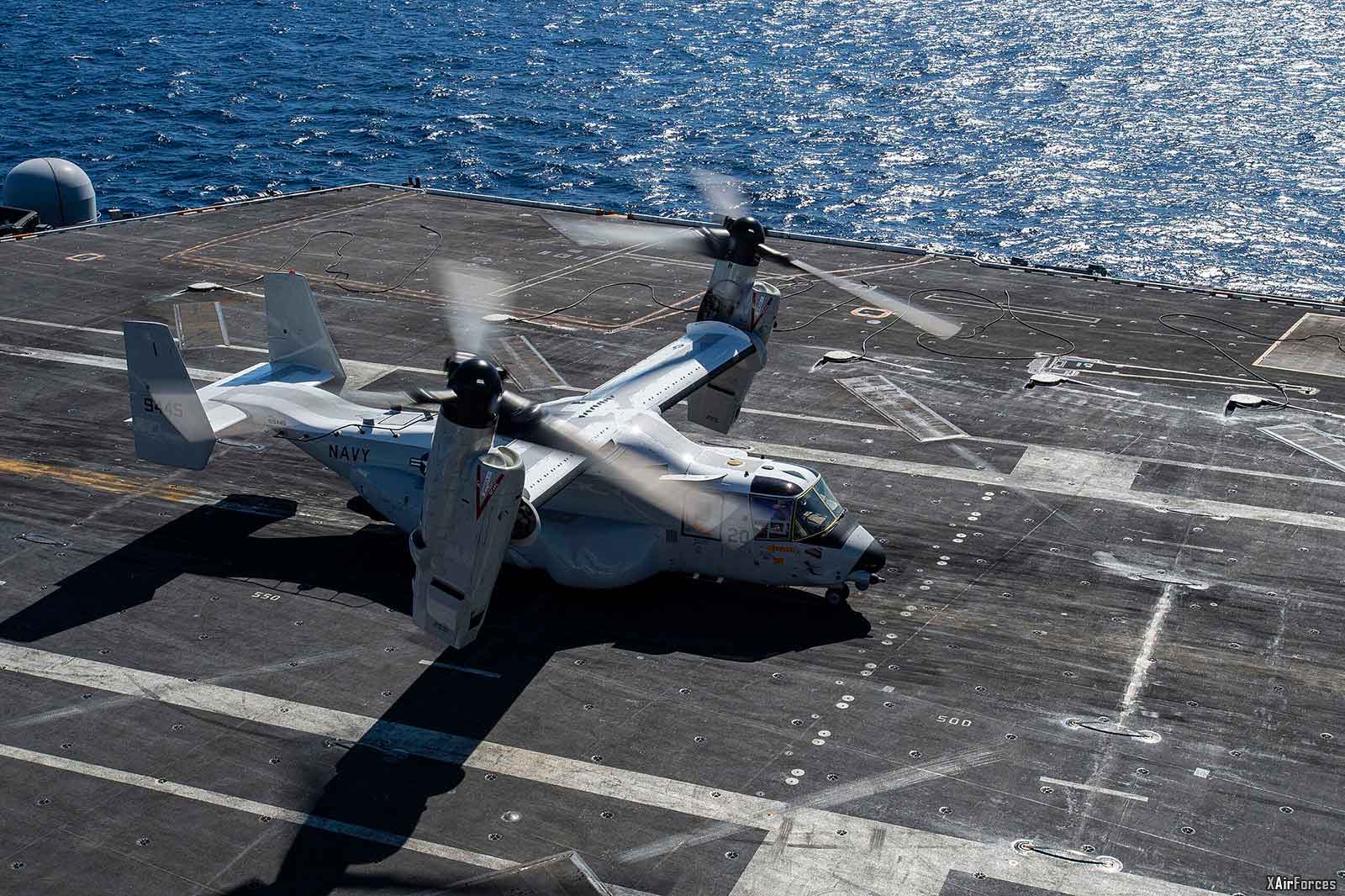 Photos: Completing two successful deployments with the U.S. Navy, the CMV-22B Osprey — a version of the V-22 tiltrotor flown by the Navy — is showing its worth. That’s what Vice Adm. Kenneth Whitesell, commander of Naval Air Forces (NAVAIR) and Naval Air Force, told The National Interest, an online international affairs magazine. Why it matters: The CMV-22 brings the critical range and capabilities the Navy needs to complete its missions. Per Whitesell, with “longer ranges, distances between multi-carrier operations, distances from land-based areas, and the ability for the CMV-22B to plop down on unimproved spaces, it proved to be a game-changer for us on deployment.”And with its “helicopter-like landing” ability on aircraft carriers day or night, the Osprey is “an asset to rapid landing, unloading, reloading and takeoff procedures,” the article states. What’s next: The CMV-22 is ready for additional deployments later this year. (Photo by Boeing)
Editor: Osman Tüfekci (©XAirForces Defense Aviation and New Technologies News Editor from Turkiye)
Keywords: USA, CMV-22B Osprey, U.S. Navy, carrier operations, Fleet Logistics Multi-Mission Squadron VRM-30, USS Carl Vinson CVN-70, F-35C Lightning II, E-2D Advanced Hawkeye, carrier-onboard-delivery COD, C-2A Greyhound, aerial refueling, increased fuel capacity, extended range, helicopter-like landing, night operations, rapid unloading, Vice Admiral Whitesell, mission completion rate 98%, mission capable rate 75%, cargo capacity, F-35 power modules, logistics support, maintenance schedule, phased maintenance, mission readiness, future carrier air wings, next-generation platforms
CMV-22B Osprey Strengthens U.S. Navy Carrier Operations
(18.09.2023)
|



 4/5 Generation Fighters